
New estimates sharpen call for coordinated action on Namibia’s large carnivores
-
- by CCF Staff August 11, 2026
FOR IMMEDIATE RELEASE
Meeting reports roughly 1,200 cheetahs, about 130 – 350 African wild dogs in 35 packs, and only around 12 desert-adapted coastal lions on the Skeleton Coast
WINDHOEK, Namibia – 11 August 2026 – New population estimates presented at a national multi-stakeholder meeting in Windhoek on Friday have underscored the urgency of coordinated action to reduce human-wildlife conflict and secure the future of Namibia’s large carnivores.
The Large Carnivore Management Association of Namibia (LCMAN), working in cooperation with the World Wildlife Fund Namibia (WWF), convened the meeting on 7 August with over 30 participants present and another 10 virtually, included government, researchers, farmers, hunters, and members of the tourism sector. Formal presentations came from Cheetah Conservation Fund (CCF), WWF, the Leibniz Institute for Zoo and Wildlife Research (IZW), the Desert Lion Conservation Project (DLCP) and the Kalahari African Wild Dog Conservation Project (KAWDCP). Other organizations in attendance included the Conservancy Association of Namibia (CANAM), the Namibia Professional Hunters Association (NAPHA), the Namibian Community Based Natural Resource Management Support Organization (NACSO), the Namibia Nature Foundation (NNF), the Integrated Rural Development and Nature Conservation (IRDNC), N/a’an ku sê Wildlife Foundation, the Kwando Carnivore Project (KCP), the Brown Hyaena Research Project (BHRP), the Hospitality Association of Namibia (HAN), United Nations Development Programme (UNDP), Ministry of Environment, Forestry and Tourism (MEFT), and several farmers and members from the tourism sector contributed to discussions on the various topics around large carnivore conservation.
Namibia is home to 34 terrestrial carnivore species, including some of Africa’s most iconic and wide-ranging predators. However, these species face increasing conservation challenges. Dr. Tim Hofmann (CCF) presented an overview showing that 11 of the 34 terrestrial carnivore species are considered either Threatened (six species) or Near Threatened (five species) in Namibia. Large carnivores are generally more threatened than medium and small carnivore species, while the cats (Felidae) have a higher proportion of threatened species (four of seven) than other carnivore families.
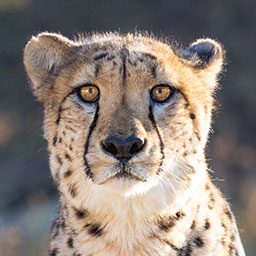
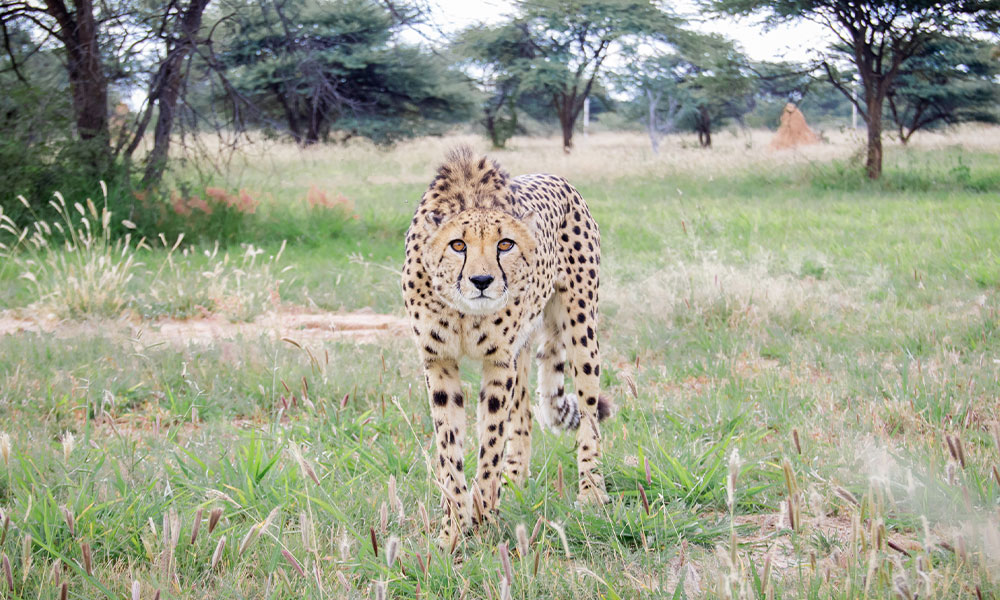
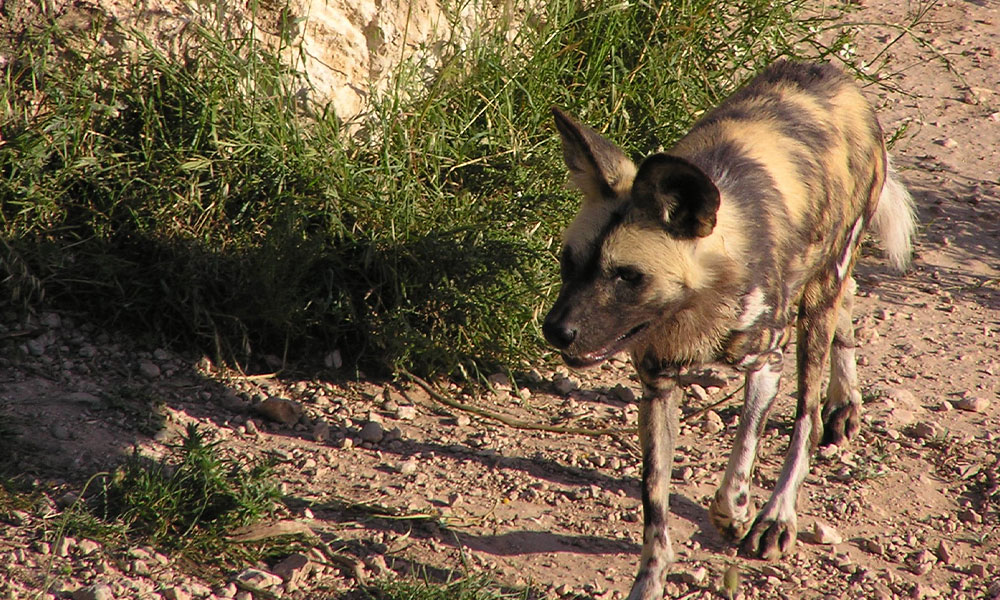
Presenters further reported that Namibia’s cheetah population is now estimated at approximately 1,200 individuals (Ruben P., IZW). African wild dogs – classified as Critically Endangered in Namibia – were estimated at about 130 – 350 animals in roughly 35 packs, with the population potentially declining (Nadja La Roux, KAWDCP). Around 12 desert-adapted lions are currently known to use the coastal habitat of the Skeleton Coast (Dr. Flip Stander, DLCP). The desert-adapted lion figure refers to this exceptional coastal group, not to the entire desert-adapted lion population of northwest Namibia. The figures are estimates derived from different monitoring approaches and survey areas, but together they show how vulnerable even Namibia’s internationally important carnivore populations remain. They also reinforce the need for repeatable monitoring, responsible data sharing, and practical support for the people living alongside these wide-ranging species.
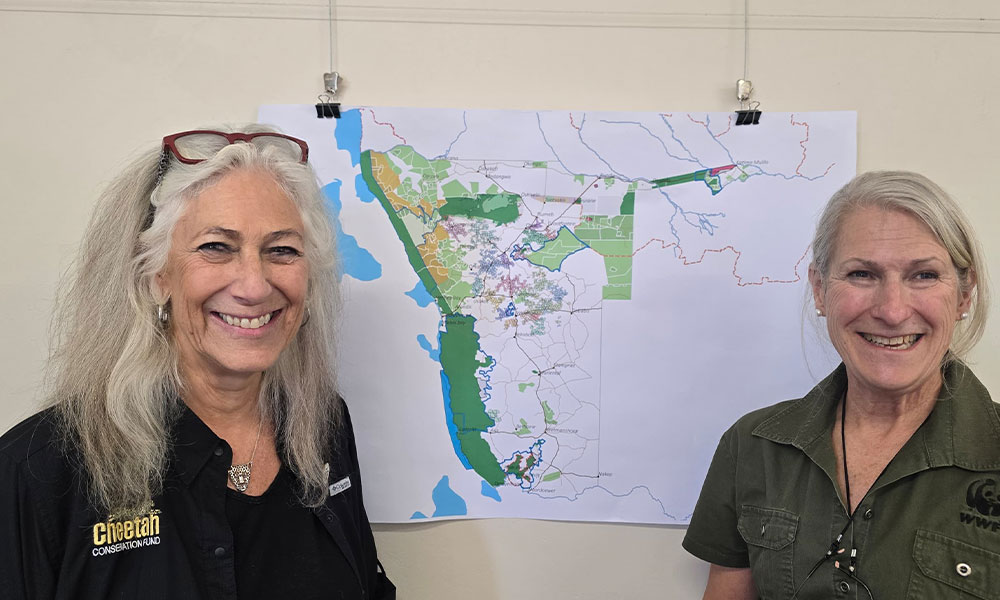
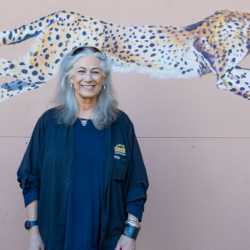
Caption: Left: Dr. Laurie Marker, Founder and Executive Director of the CCF, and Chair of the LCMAN, “Right: Dr. Pauline Lindeque, Wildlife and Landscapes Programme Director at WWF.
Quote Dr. Laurie Marker: ” The updated figures are a warning and a call to action. Namibia remains a global stronghold for large carnivores, but their future depends on practical support for the farmers, conservancies, and communities who share the landscape with them.”
Quote Dr. Pauline Lindeque: “The meeting showed that Namibia has the science, field experience and emerging finance tools to act. The priority now is to connect them through a coordinated national approach that reduces conflict and delivers measurable benefits for people and wildlife.”
About the meeting
The Multi-Stakeholder Working Meeting on Human-Wildlife Conflict and Large Carnivore Conservation in Namibia was held on 7 August 2026 at the Community Conservation and Inspiration Hub in Windhoek West, with additional online participation. It combined species-status updates, solution briefings and discussion of national implementation and accurate data sharing.
Discussion underscored that protected areas alone cannot secure wide-ranging carnivores. Farmers, conservancies, traditional and local institutions, private landholders, and rural communities are central to conservation outcomes and need practical support to live and produce alongside predators.
Participants examined a set of complementary approaches, including:
- Other Effective Area-Based Conservation Measures (OECMs), which can recognize sustained biodiversity conservation outside formal protected areas;
- Wildlife credits and other results-based payment for ecosystem services mechanisms that could direct value to communities and land managers delivering verified conservation outcomes;
- Early warning technology that can help landholders and response teams act before a conflict event occurs;
- Context-specific livestock protection, deterrence, monitoring, education and rapid-response measures; and
- Ecosystem stewardship certification that could strengthen market recognition for responsible production and coexistence.
Four priorities emerged from the meeting:
- First, Namibia needs coordinated, comparable data on carnivore populations, conflict incidents and mitigation performance, with clear safeguards and useful feedback to contributors.
- Second, proven conflict-prevention tools must reach more producers and communities through practical training, trusted local partners and reliable response systems.
- Third, the cost of conserving wildlife on working land should not fall mainly on households, farms or conservancies. Conservation finance, market access and stewardship recognition can help align wider conservation benefits with local livelihoods.
- Fourth, national progress requires sustained cooperation among government, producers, conservancies, hunting and tourism interests, researchers, conservation organizations and private-sector partners. Solutions should be tested, measured against common indicators and adapted before wider rollout.
The meeting also highlighted the importance of clear public communication. Stakeholders emphasized the need to share accurate, understandable information nationally, address misinformation and ensure that farmers and communities help shape both the message and the solution.
The new species estimates provide an immediate benchmark for public communication and future monitoring. The working meeting also provided a foundation for follow-up on shared evidence standards, integrated pilot landscapes, conservation finance and stewardship mechanisms, and a more coordinated national approach to human-wildlife conflict.
Namibia’s long conservation record and extensive field experience provide a strong base. The next task is to translate that experience into a durable system that reduces conflict, strengthens rural resilience and maintains viable large-carnivore populations for future generations.
Media contact
Dr. Laurie Marker, LCMAN
[email protected], WhatsApp: +264811247887
Dr. Pauline Lindeque, WWF [email protected]
Margretha Kampulu, WWF [email protected]
About LCMAN
Formalised in 2001 after beginning as an informal forum in 1996, the Large Carnivore Management Association of Namibia (LCMAN) is a not-for-profit umbrella network bringing together stakeholders from farming, research, conservation, hunting and government to support Namibia’s free-ranging carnivores including lions, leopards, cheetahs, hyaenas and African wild dogs. Its work includes reducing human–wildlife conflict, coordinating research and national assessments such as the Carnivore Red Data Book, and supporting science-based policy and management standards. For more information: www.carnivore-Namibia.org
About the Cheetah Conservation Fund – The Cheetah Conservation Fund (CCF) is the global leader in research and conservation of cheetahs and is dedicated to saving cheetahs in the wild. CCF has created a set of integrated conservation programs to address threats to the cheetah and its ecosystem. Founded in 1990, CCF is an international non-profit organization headquartered in Namibia with a field base in Somaliland. CCF is the longest running cheetah conservation organization and has restored thousands of acres of Namibian farmland, established a training program to enhance the livelihoods of thousands of rural residents. One of their signature programs is the livestock guarding dog program, where nearly 800 Anatolian and Kangal guarding dogs have been bred and placed with farmers since 1994 to protect their livestock from predators. The CCFs Research and Education Centre is based on near Otjiwarongo within the Waterberg Conservancy, on a private wildlife reserve and model farm. In 2017, CCF set up a field base in Somaliland to care for confiscated cheetah cubs from the illegal wildlife pet trade and have developed programs in the Horn of Africa to help stop the illegal wildlife trade.
For more information about CCF’s work and how you can help protect cheetahs in the wild please visit www.cheetah.org
About WWF Namibia
WWF Namibia works with government, communities and partners to conserve biodiversity, restore habitats and strengthen livelihoods. Its work seeks to ensure that Namibia’s wildlife and wild places deliver lasting benefits for people while building resilience across the country and wider region. For more information contact: [email protected] or [email protected]
Related Reading